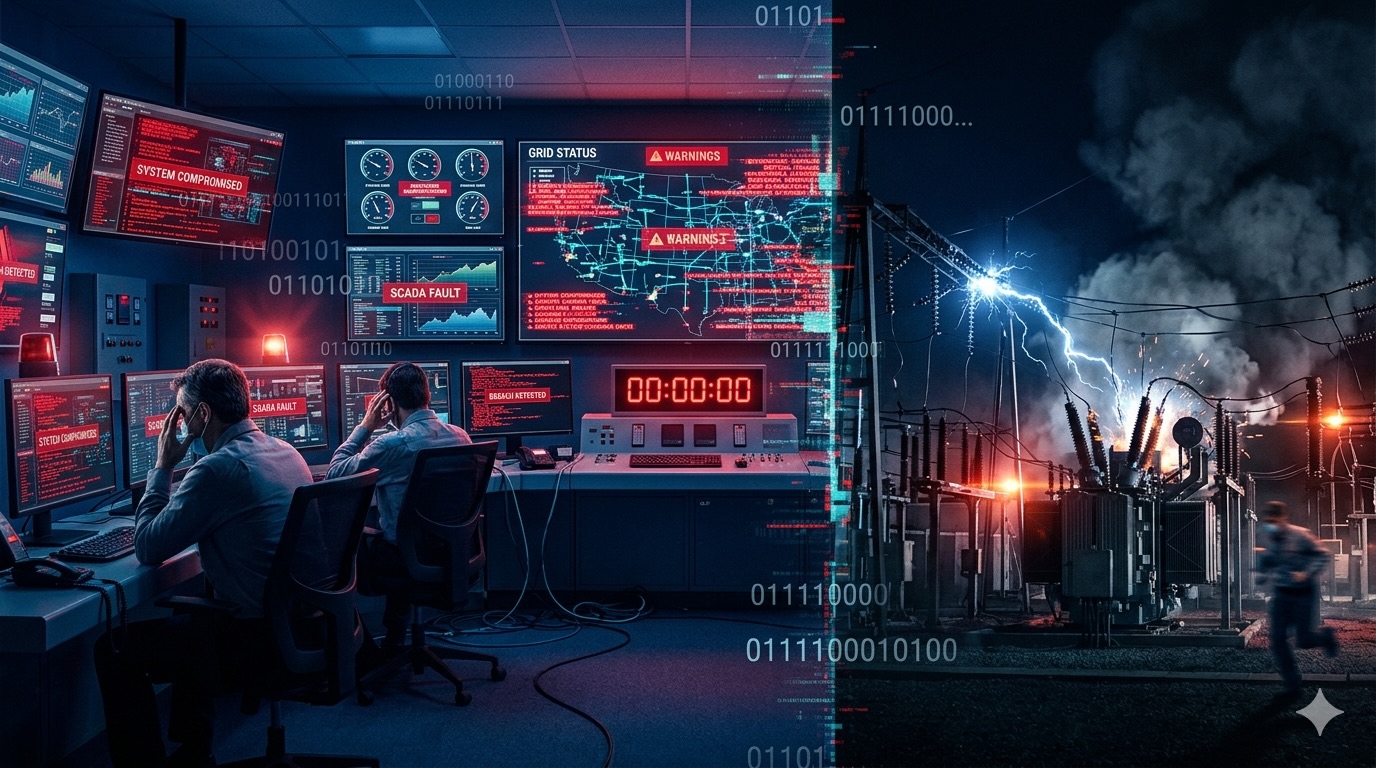
December 23, 2015. 3:35 PM local time. Western Ukraine.
Power grid operators watch their screens in disbelief as their cursors move independently. They're locked out of their own systems. One by one, circuit breakers open remotely. Substations go dark.
230,000 people lose power in the middle of winter.
This wasn't a malfunction. This was **BlackEnergy** and **KillDisk**—malware designed with a singular purpose: cross the boundary from digital intrusion to physical destruction.
Welcome to the era of **cyber-kinetic warfare**, where hackers don't steal your data. They destroy your reality.
The SCADA Illusion: The Fragile Digital Thread Holding Civilization Together
Most people don't know what SCADA stands for. They should.
**Supervisory Control and Data Acquisition**—the industrial control systems that manage everything from power grids to water treatment plants, from oil pipelines to traffic signals. The invisible nervous system of modern civilization.
Here's the terrifying truth: most of it was never designed for security.
The Legacy Problem: Industrial Systems in a Hostile Digital Age
SCADA systems were engineered in the 1960s and 70s, when "network security" meant a locked door and a security guard. These systems were **air-gapped**—physically isolated from external networks. The assumption was simple: if it's not connected to the internet, it's safe.
That assumption is now lethally obsolete.
Modern efficiency demands connectivity. A power company needs to monitor substations remotely. A water treatment facility must coordinate with municipal systems. A chemical plant requires real-time optimization across multiple sites.
So they connected everything. And they did it using protocols that were never designed for adversarial environments.
**Modbus**, created in 1979, has zero authentication. Any command sent to a Modbus device is assumed to be legitimate. There's no encryption. No verification. Just blind trust.
**DNP3** (Distributed Network Protocol) is marginally better but still fundamentally trusting. It was designed for reliability in harsh industrial environments, not security against nation-state attackers.
**OPC** (OLE for Process Control) allows Windows-based systems to communicate with industrial hardware. It's convenient. It's also riddled with the same vulnerabilities that plague consumer Windows systems.
The result? **Critical infrastructure running on protocols from an era when the biggest security threat was a disgruntled employee, not the Russian GRU.**
The Convergence: When IT Meets OT
The collision between Information Technology (IT) and Operational Technology (OT) created a massive attack surface.
Traditional IT security focuses on data: confidentiality, integrity, availability. The classic CIA triad.
OT security has different priorities: **safety, reliability, uptime**. A power grid can't go offline for security patches. A chemical plant can't reboot its safety systems during a Windows update.
This fundamental tension creates exploitable gaps.
Corporate networks get breached—it happens constantly. But when that corporate network shares infrastructure with the SCADA system controlling a natural gas pipeline, a routine data breach becomes a potential explosion.
The **Purdue Model** was supposed to create separation—distinct layers between business systems and industrial control systems. But in practice, organizations violate this separation constantly. A VPN here, a remote access point there, a contractor's laptop with dual network access.
Each violation is a bridge for attackers to cross from the digital realm into the physical world.
The Stuxnet Precedent: When Code Became a Weapon of Mass Destruction
June 2010. Security researchers at VirusBlokAda in Belarus discover anomalous malware. It's sophisticated beyond anything they've seen. It spreads via USB drives. It targets specific Siemens PLCs (Programmable Logic Controllers). It has **four zero-day exploits**—an unprecedented arsenal.
This was **Stuxnet**, and it represented a paradigm shift in cyber warfare.
Operation Olympic Games: The Digital Manhattan Project
Stuxnet was the product of a joint U.S.-Israeli intelligence operation, codenamed **Olympic Games**. The target: Iran's nuclear enrichment program at Natanz.
The objective wasn't data theft or espionage. It was **sabotage**.
The malware's sophistication revealed the resources behind it:
**Four zero-day exploits** to spread and gain privileges—representing millions in development costs or black market purchases.
**Stolen digital certificates** from legitimate companies (Realtek and JMicron) to appear as trusted software.
**Detailed knowledge of Natanz's specific configuration**—the exact model of Siemens S7-315 and S7-417 PLCs, the precise centrifuge cascade design, the rotational speeds of IR-1 centrifuges.
This wasn't malware. This was a **precision-guided digital weapon**.
The Attack Sequence: Mechanical Destruction Through Code
Stuxnet's kill chain was elegant and devastating:
**Step 1: Infiltration**. USB drives carried the payload across the air gap. Iranian nuclear facilities, isolated from the internet for security, were vulnerable to the oldest attack vector: human behavior.
**Step 2: Reconnaissance**. Once inside, Stuxnet mapped the network, looking for specific Siemens STEP 7 software and particular PLC configurations.
**Step 3: Weaponization**. When it found its target, it injected malicious code into the PLC logic, creating two attack modes:
**Mode 1: Overspeed Attack**. Centrifuges normally spin at 1,064 Hz. Stuxnet would suddenly increase speed to 1,410 Hz for 15 minutes, then drop to 2 Hz, then return to normal. This cycle repeated, causing catastrophic mechanical stress.
**Mode 2: Frequency Manipulation**. More subtle variations in rotor speed that caused cumulative damage over months.
**Step 4: Concealment**. The genius move—Stuxnet would record normal sensor readings and play them back to operators. While centrifuges were tearing themselves apart, the control room saw normal operations.
"We had to replace 1,000 centrifuges. They kept breaking. We didn't know why." — Former Iranian nuclear technician, 2011
Iran lost approximately **20% of its centrifuge capacity**. Physical machines, destroyed by invisible code. Uranium enrichment was set back by an estimated **two years**.
This was the proof of concept: **cyber attacks can cause kinetic damage**.
The Pandora's Box
Stuxnet's discovery revealed the blueprint for cyber-kinetic warfare to the world. The malware was reverse-engineered. Its techniques were documented. Its code was studied by nation-states and criminal groups alike.
The genie was out of the bottle.
Within years, we saw **Duqu** (Stuxnet's reconnaissance sibling), **Flame** (massive espionage platform), and eventually **Industroyer** and **Triton**—malware specifically designed to destroy industrial systems.
The precedent was set: if code can destroy Iranian centrifuges, it can destroy anything controlled by computers. Which, in 2024, is virtually everything.
The Kill Switch: Modern Cyber-Kinetic Attacks
Stuxnet was state-sponsored, highly targeted, and unprecedented. What came next was worse: the democratization of infrastructure attacks.
Ukraine: The Testing Ground
Ukraine has become the real-world laboratory for cyber-kinetic warfare.
**December 2015: BlackEnergy**. The first confirmed cyber attack causing power grid failure. Attackers gained access to multiple electricity distribution companies, deployed malware, opened breakers, and prevented operators from regaining control. 230,000 people lost power for 1-6 hours.
The attack used relatively simple techniques but proved the concept.
**December 2016: Industroyer (CrashOverride)**. This was different. This was **purpose-built malware for destroying power infrastructure**.
Industroyer understood industrial protocols: **IEC 60870-5-101**, **IEC 60870-5-104**, **IEC 61850**, **OPC DA**. It could speak the language of power grid equipment directly.
The attack on Kyiv's Ukrenergo transmission station cut power to a fifth of the city—about 200 MW of capacity. The malware was designed to cause long-term damage, not just temporary outages.
But the critical detail: **Industroyer included a wiper component**. It wasn't just about disruption. It was about destruction—erasing systems to prevent quick recovery.
"This malware represents a threat to critical infrastructure operators worldwide. What we saw in Ukraine could happen anywhere." — Anton Cherepanov, ESET Senior Malware Researcher
**2022-Present: Ongoing Cyber Warfare**. Russia's full-scale invasion included coordinated cyber attacks on Ukrainian infrastructure. **Wiper malware** (HermeticWiper, IsaacWiper, CaddyWiper) attempted to destroy systems. Attacks targeted power, telecommunications, and government systems.
Ukraine's infrastructure remains standing largely due to unprecedented defensive support from Western cybersecurity firms and rapid incident response. But the attacks revealed a chilling reality: **modern warfare includes cyber components designed to destroy civilian infrastructure**.
Oldsmar, Florida: The Water Treatment Hack
February 5, 2021. A small water treatment facility in Oldsmar, Florida.
An operator notices his cursor moving remotely—someone has accessed the system via TeamViewer. He assumes it's a supervisor. The intruder accesses the software controlling chemical treatment and changes the **sodium hydroxide (lye) level from 100 parts per million to 11,100 ppm**.
This wasn't espionage. This was **attempted poisoning of a city's water supply**.
At 11,100 ppm, sodium hydroxide would cause severe chemical burns, respiratory damage, and potentially death to anyone who consumed the water.
The operator caught it immediately and reversed the change. But the implications are staggering:
**Poor Security Practices**: The system used an outdated Windows 7 computer, shared passwords, and remote access software with no multi-factor authentication.
**Low Sophistication Required**: The attacker didn't use zero-days or advanced techniques. They used legitimate remote access software that was poorly secured.
**Immediate Physical Harm**: Unlike data breaches, this attack could have directly harmed or killed people within hours.
The attacker was never identified. Was it a nation-state probing defenses? A criminal group testing capabilities? A lone hacker demonstrating vulnerability?
We don't know. That's almost more terrifying than the attack itself.
Triton/Trisis: The Safety System Assassin
August 2017. A petrochemical plant in Saudi Arabia.
The **Triconex Safety Instrumented System (SIS)**—the last line of defense against catastrophic industrial accidents—was compromised. Malware, later named **Triton** or **Trisis**, was deployed to reprogram the safety controllers.
SIS systems are designed to shut down processes before they become dangerous. They're the emergency brake. The failsafe. The system that prevents explosions, toxic releases, and industrial disasters.
Triton was designed to **disable those safety systems**.
The malware could have caused a catastrophic explosion or toxic release. It didn't, only because of a flaw in the attack code that triggered safety systems to enter a fail-safe mode, alerting operators.
Attribution pointed to the **Central Scientific Research Institute of Chemistry and Mechanics (CNIIHM)** in Moscow—a Russian government research institution.
This represented a new escalation: **attacks designed not just to disrupt operations, but to cause maximum physical damage and potential loss of life**.
The Anatomy of Vulnerability: Why We're So Exposed
The cyber-kinetic attack surface is massive and growing.
The Remote Access Problem
Industrial systems increasingly support remote access for legitimate operational reasons:
- Maintenance technicians need to diagnose issues without traveling to remote sites
- Vendors need to provide support and software updates
- Operators need to respond to emergencies from home
Each remote access point is a potential attack vector. **TeamViewer, VNC, RDP**—convenient tools that, when poorly secured, become highways for attackers.
The Supply Chain Weakness
Industrial control systems rely on complex supply chains. A compromised vendor, a malicious contractor, a backdoored update—any of these can introduce malware into isolated environments.
**SolarWinds** (2020) demonstrated this at enterprise scale. The same techniques apply to industrial systems. When you trust a vendor's software updates, you're trusting their entire security infrastructure.
The Human Factor
Social engineering doesn't stop at corporate email systems.
**USB drives** left in parking lots compromise air-gapped systems. **Phishing emails** to facility operators steal VPN credentials. **Insider threats**—disgruntled employees with intimate knowledge of systems—represent worst-case scenarios.
You can't patch human behavior.
The Convergence of IT and OT
Modern SCADA systems run on Windows, Linux, or embedded operating systems with known vulnerabilities. They use standard networking protocols. They connect to corporate networks, cloud services, and the internet.
This convergence enables efficiency and remote management. It also enables **lateral movement** from compromised IT systems to critical OT infrastructure.
A ransomware attack targeting corporate files suddenly has a path to PLCs controlling chemical processes.
The Future of Cyber-Kinetic Warfare: The Nightmare Scenarios
The attacks we've seen are just the beginning.
Scenario 1: Ransomware Meets Life Support
Hospitals are soft targets. **Ransomware attacks on healthcare systems** occur weekly. Usually, they encrypt patient records and billing systems. Disruptive, expensive, but not immediately lethal.
Now imagine ransomware that targets **medical devices**. Insulin pumps with wireless connectivity. Pacemakers with remote monitoring. Ventilators controlled by networked systems.
Researchers have demonstrated these vulnerabilities in controlled settings. **FDA warnings** have been issued about specific medical devices. But millions remain deployed, often running outdated software that can't be easily updated without breaking FDA certification.
The kill chain: compromise hospital network, pivot to medical device management systems, deploy payload that locks or alters critical device functions, demand ransom with an explicit time limit before patients die.
This hasn't happened yet at scale. But the technical capability exists.
Scenario 2: Traffic Control Chaos
Modern cities use **intelligent traffic management systems**—networked signals, sensors, and controls designed to optimize flow and respond to emergencies.
A coordinated attack could:
- Create gridlock by forcing all signals to red or green simultaneously
- Prevent emergency vehicle routing priority
- Cause accidents by manipulating signal timing at high-speed intersections
- Disable public transportation systems
The 2022 **Iran train station hack** demonstrated a taste of this—fake messages about train delays and cancellations caused mass confusion. Expand that to an entire city's infrastructure.
Scenario 3: The Cascade Failure
The **Texas power grid failure** in February 2021 showed how interconnected systems fail in cascades. Cold weather caused one failure, which triggered another, which overloaded systems, causing more failures.
A cyber attacker could artificially create similar cascades:
- **Destabilize power grid frequency** by manipulating generation or load
- **Trip circuit breakers** in coordinated patterns that overload remaining capacity
- **Prevent automatic protective relays** from functioning correctly
- **Attack during peak demand** to maximize impact
The goal isn't just a blackout. It's **physical damage to generation and transmission equipment**—transformers, turbines, substations—that takes months or years to replace.
Imagine a multi-state blackout lasting not hours or days, but weeks.
Scenario 4: The Water Wars
Water systems represent high-impact, low-security targets:
- **Water treatment**: Manipulate chemical dosing (like Oldsmar, but successful)
- **Dam control**: Release or withhold water to cause floods or droughts
- **Wastewater systems**: Create environmental disasters or public health emergencies
- **Desalination plants**: Poison or deny water to coastal cities dependent on them
The **2021 Israel water system attacks** allegedly attempted to manipulate chlorine levels in water supplies. Attribution was murky, but the intent was clear: turn essential infrastructure into a weapon.
The Defense Problem: Why We Can't Just "Patch It"
Traditional cybersecurity doesn't translate to industrial environments.
**Patching cycles** measured in months or years, not days. A power grid can't go offline for updates during peak demand.
**Legacy systems** that are 20-30 years old, running software that can't be updated without breaking certification or requiring multimillion-dollar replacements.
**Safety vs. Security trade-offs**. In industrial environments, safety takes priority. If a security measure might prevent emergency shutdowns, it won't be implemented.
**Complexity and interdependence**. Modern grids, water systems, and transportation networks are massively complex with thousands of interconnected components. Securing every endpoint is practically impossible.
**Insider knowledge requirements**. Defending these systems requires understanding both cybersecurity AND industrial processes—a rare combination of expertise.
The Geopolitical Reality: State-Sponsored Infrastructure Targeting
Nation-states are developing offensive cyber-kinetic capabilities:
**Russia**: Demonstrated willingness to attack civilian infrastructure (Ukraine). Sandworm Team/Unit 74455 specializes in infrastructure attacks.
**China**: Volt Typhoon campaign targeting U.S. critical infrastructure with pre-positioning malware designed to activate during conflicts.
**Iran**: Retaliatory attacks on industrial targets, including the 2012 **Shamoon** attacks on Saudi Aramco and multiple attacks on U.S. infrastructure.
**North Korea**: Increasingly sophisticated capabilities, though focused more on financial theft than infrastructure destruction (so far).
**United States**: Stuxnet proved U.S. offensive capabilities. **Cyber Command** has acknowledged pre-positioning operations in adversary infrastructure.
The logic is simple and terrifying: if kinetic warfare breaks out, cyber attacks on infrastructure are force multipliers. Disrupt power, water, communications, and transportation before the first missile launches.
**Pre-positioned malware** in critical infrastructure is the cyber equivalent of landmines. They sit dormant, waiting for activation during crisis.
The Bottom Line: We Live on a Knife's Edge
The infrastructure sustaining modern civilization—power, water, transportation, healthcare—is **fundamentally insecure**.
The protocols are vulnerable. The systems are outdated. The attack surface is massive. The defenses are inadequate.
What separates us from catastrophe isn't robust security. It's primarily the fact that **most attackers haven't chosen to pull the trigger** on maximum-damage cyber-kinetic attacks.
Stuxnet proved physical destruction via code is possible. Ukraine proved power grids can be remotely disabled. Oldsmar proved water systems can be remotely poisoned. Triton proved safety systems can be sabotaged.
These weren't hypotheticals. These were demonstrations.
The technical capability exists. The targets are identified. The attack tools are developed.
The next time your lights flicker, your water pressure drops, or your hospital's systems go offline, there's a question you should ask:
Was that a glitch, or was that a warning?
Because somewhere in the world, an analyst is staring at network traffic from a power substation, recognizing a pattern that shouldn't exist, realizing that someone is **already inside**.
The question isn't whether cyber-kinetic attacks will escalate.
The question is what happens when they do.
And whether our fragile infrastructure can survive the answer.