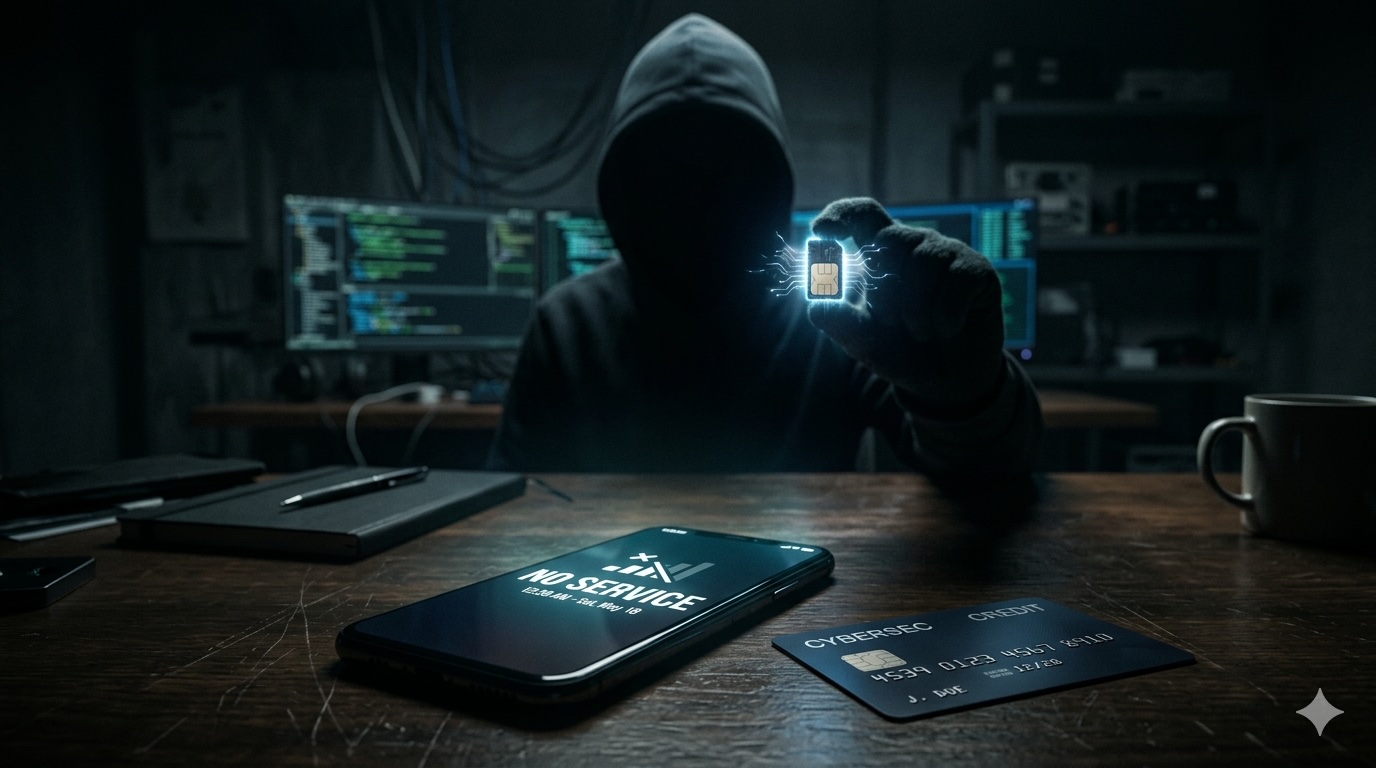
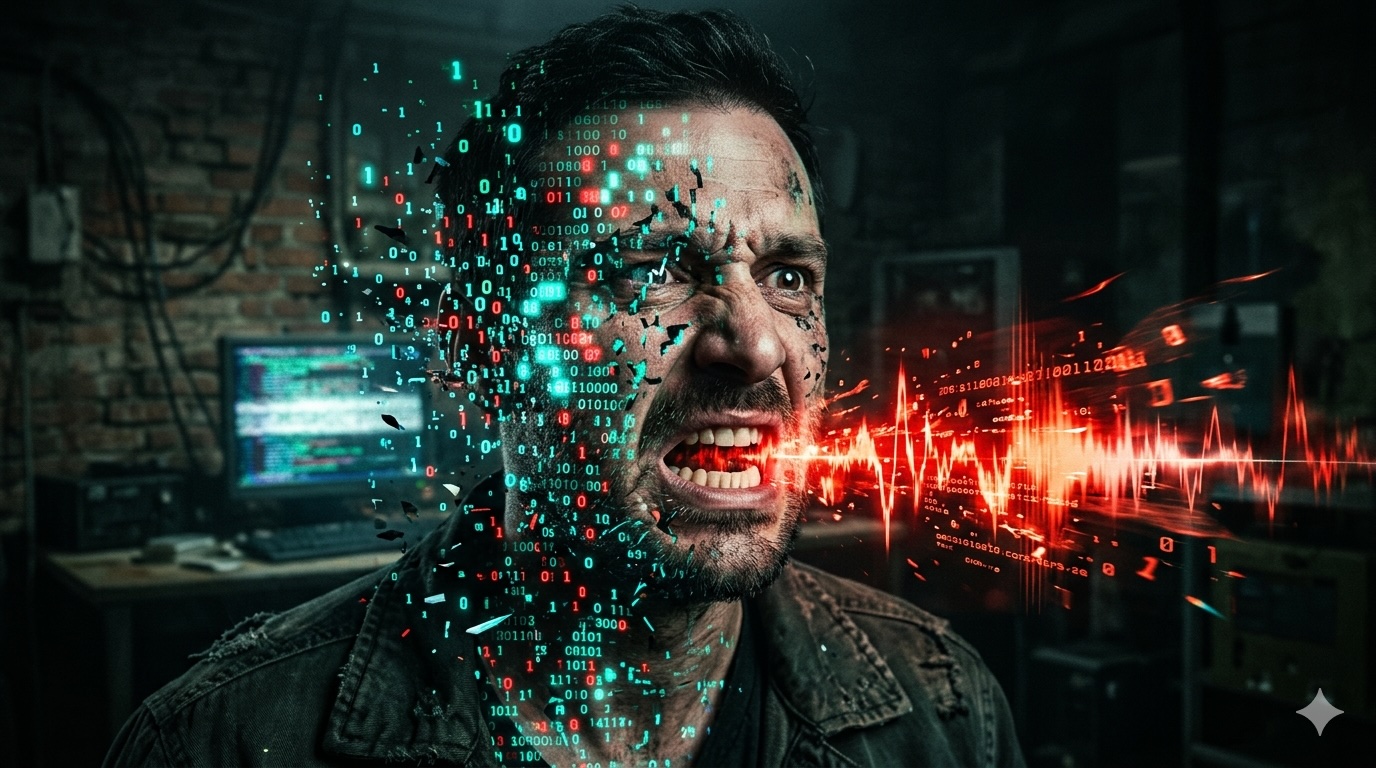
The End of the Era of Trust: Welcome to the Synthetic Nightmare
For decades, cybersecurity focused on defending data. Passwords. Credit cards. Social Security numbers. Files. The paradigm was simple: **protect information, prevent unauthorized access, encrypt sensitive data.**
That era is over.
We have entered a new phase of digital warfare where the target is no longer your data. **The target is your biometric identity itself.** Your face. Your voice. Your mannerisms. The very essence of what makes you recognizable as you. And the most devastating truth? **Attackers don't need to steal these biometrics anymore. They can synthesize them from scratch using nothing but publicly available AI models and three seconds of audio.**
The shift is paradigm-shattering. Hacking is no longer about breaking into systems. It's about **breaking reality itself.** When your mother calls you in tears, begging for money because she's been in an accident, how do you know it's actually her? When your CEO appears on a Zoom call demanding an immediate wire transfer, how do you verify it's not a deepfake? When a video surfaces showing you saying something you never said, how do you prove your innocence?
**We have arrived at Zero-Trust Reality** – a world where audio and video evidence, once considered irrefutable proof, can no longer be trusted. The courtroom concept of "hearing is believing" has been obliterated. The familial instinct to recognize your child's voice crying for help has been weaponized against you.
This isn't science fiction. This isn't a distant theoretical threat. **This is happening right now, at industrial scale, targeting ordinary families.**
In 2023, a mother in Arizona received a phone call. She heard her 15-year-old daughter's voice screaming, crying, begging for help. The voice was perfect. Every inflection. Every sob. Every terrified gasp. The kidnappers demanded $1 million. They knew her daughter's name. They had her exact vocal signature. The mother was convinced her daughter had been abducted.
**Her daughter was safe at a ski trip. The entire kidnapping was synthetic.** The voice was cloned using AI from a few Instagram stories the teenager had posted. The emotional distress was algorithmically generated. The ransom demand was psychological warfare designed to bypass rational thinking and trigger primal parental panic.
This is the new frontier of cybercrime: **synthetic identity exploitation.** Attackers have moved beyond phishing emails and malware. They're now deploying weaponized AI to manufacture reality itself, creating audio and video evidence of events that never occurred, leveraging the deepest human vulnerabilities – trust in sensory perception and love for family members.
The technology enabling this nightmare is not locked away in government laboratories. It's not restricted to nation-state actors with billion-dollar budgets. **It's free. It's open-source. It's accessible to anyone with a laptop and an internet connection.** The barrier to entry for creating devastatingly convincing deepfakes has collapsed from requiring specialized expertise to being executable by script kiddies following YouTube tutorials.
The psychological implications are staggering. We evolved for millennia to trust our senses. To recognize voices. To identify faces. To believe what we see and hear. **That evolutionary programming is now a critical security vulnerability.** Every video call could be a deepfake. Every voice message could be synthetic. Every piece of media could be manufactured.
And the most terrifying aspect? **The technology improves exponentially while human ability to detect deepfakes remains static.** We are rapidly approaching – or have already reached – the point where synthetic media is indistinguishable from authentic recordings, even to trained experts using sophisticated detection tools.
This isn't about preventing data breaches anymore. **This is about defending the very concept of truth in an age where reality can be synthesized on demand.** And the first battleground isn't corporate networks or government infrastructure. It's your family. Your voice. Your face. Your identity.
The 3-Second Weapon: The Terrifying Engineering Behind Voice Cloning
Let me explain exactly how threat actors weaponize your voice using artificial intelligence. The technical process is both elegantly simple and horrifyingly effective.
**Voice cloning technology relies on Deep Learning neural networks**, specifically architectures designed for audio synthesis. The most commonly deployed models use **Generative Adversarial Networks (GANs)** combined with **WaveNet-style architectures** or **transformer-based models** to analyze and replicate human speech patterns.
Here's the clinical breakdown of how your voice becomes a weapon:
Phase One: Audio Sample Collection
The attacker needs source material – recordings of your voice. Not hours of audio. Not professional studio recordings. **Just 3-10 seconds of clean speech is sufficient for modern AI voice cloning tools.**
Where do they get this audio?
**Social media is a goldmine.** Instagram Stories. TikTok videos. Facebook videos. YouTube comments or vlogs. LinkedIn video posts. Clubhouse recordings. Twitter Spaces. Every platform where you've spoken on camera or recorded audio is a potential sample source.
**Public sources are equally valuable.** Podcast appearances. Webinar presentations. Conference talks. Corporate training videos. Court testimony recordings. Public meeting minutes that were recorded. Local news interviews.
The attacker downloads the video, extracts the audio track, isolates your voice from background noise using readily available audio processing software, and feeds it into the AI model.
Phase Two: Voice Analysis and Feature Extraction
The AI model analyzes your voice sample with terrifying precision, extracting hundreds of unique vocal characteristics:
**Prosodic features** – your rhythm, stress patterns, intonation curves, and speaking tempo
**Acoustic features** – fundamental frequency (pitch), harmonics, formant frequencies, and spectral characteristics
**Phonetic patterns** – how you pronounce specific sounds, your accent, regional dialect markers
**Temporal dynamics** – breath patterns, pause lengths, speech rate variations
**Emotional baselines** – your natural emotional range and expression patterns
The model creates a comprehensive **vocal fingerprint** – a mathematical representation of everything that makes your voice uniquely yours. This fingerprint is then encoded into a latent space representation that the generative model can manipulate.
Phase Three: Synthesis and Emotional Manipulation
This is where the technology becomes truly nightmarish. Modern voice cloning systems don't just replicate your neutral speaking voice. **They can synthesize emotions you never expressed.**
Using **emotion transfer algorithms**, attackers can make your cloned voice:
**Cry convincingly** – adding vocal fry, pitch breaks, sobbing patterns, and tremulous breathiness
**Scream in terror** – incorporating panic markers, elevated pitch, rapid speech rate, and acoustic distress signals
**Plead desperately** – modulating prosody for urgency, adding vocal strain, inserting realistic hesitations
**Express love naturally** – warming the tone, softening consonants, adding affectionate inflection patterns
The synthesized audio includes micro-details that make it indistinguishable from authentic recordings:
- **Breath sounds** at natural intervals
- **Lip smacks and mouth noises** that occur in normal speech
- **Background acoustic signatures** matching the claimed environment (car noise for "kidnapped in a vehicle," room echo for "locked in a basement")
- **Realistic imperfections** like slight pitch variations and natural speech disfluencies
The result is audio that **passes not just casual listening but often survives scrutiny from family members who have heard your voice thousands of times.** The emotional authenticity is so precise that it bypasses rational skepticism and triggers immediate emotional response.
Phase Four: Real-Time Synthesis Capabilities
The truly terrifying evolution is **real-time voice conversion.** Attackers can now clone your voice and speak through it in real-time during phone calls.
**Voice conversion software** (like so-vits-svc, RVC, or commercial solutions) allows an attacker to:
1. Speak normally into a microphone
2. Have their voice instantly converted to your vocal signature
3. Modulate emotions on-the-fly during conversation
4. Respond to questions and maintain dialogue while sounding exactly like you
This eliminates the limitation of pre-recorded clips. The attacker can have a full conversation with your family members, **answering questions about specific family details they've researched through social engineering**, creating an interactive kidnapping scenario that feels completely authentic.
The Accessibility Horror
Here's what should truly terrify you: **this technology is free and trivially easy to deploy.**
Open-source voice cloning tools available right now include:
- **Coqui TTS** (Text-to-Speech with voice cloning)
- **Tortoise TTS** (high-quality voice synthesis)
- **RVC (Retrieval-based Voice Conversion)** (real-time voice changing)
- **So-VITS-SVC** (singing voice conversion, but equally effective for speech)
Each of these can be installed and operational in under an hour. Training a voice model on your three-second audio sample takes 10-30 minutes on consumer hardware. The cost to clone your voice? **Zero dollars.**
Commercial services make it even easier. Platforms like ElevenLabs, Play.ht, and Resemble.ai offer voice cloning as a service – upload a sample, get a cloned voice. While legitimate companies implement safeguards, **bypass techniques are widely shared in underground forums.**
The mathematical reality is inescapable: **the complexity of defending against voice cloning is exponentially higher than the simplicity of deploying it.** Attackers have overwhelming asymmetric advantage.
Virtual Kidnapping: The Weaponization of Synthetic Love
Let me walk you through the operational anatomy of a virtual kidnapping attack. This isn't hypothetical threat modeling. **This is the documented playbook being executed against families every single day.**
The Target Selection Phase
Attackers don't select victims randomly. They conduct **OSINT reconnaissance** to identify high-value targets with specific vulnerabilities:
**Wealthy families** – identified through property records, LinkedIn executive positions, luxury vehicle registrations, and public tax filings
**Families with teenagers** – teens are prolific social media users who provide abundant voice samples
**Elderly parents of successful adults** – cognitive decline makes them more susceptible to panic and less likely to verify
**Single parents** – heightened protective instincts and sole decision-making authority
The reconnaissance phase maps the family structure, daily routines, relationships, and most critically, **sources of audio samples.**
The Engineering Phase
Once a target is selected, the attacker executes the technical preparation:
**Step 1: Audio harvesting.** The attacker downloads social media videos, isolates the target's voice (usually a child or vulnerable family member), and processes the audio to remove background noise and music.
**Step 2: Voice model training.** The audio is fed into the cloning system. Within 30 minutes, the AI has created a synthetic voice indistinguishable from the original.
**Step 3: Script preparation.** The attacker writes a emotional script designed to bypass rational thinking:
"Mom! Mom, please help me! These men grabbed me outside school! They have a gun! Please, Mom, I'm so scared! They said they'll kill me if you call the police! They want money! Please just give them what they want! I don't want to die! Mom, please!"
The script is engineered with **psychological precision**:
- **Immediate emotional shock** to prevent rational analysis
- **Specific prohibitions** against calling authorities
- **Urgency timelines** to compress decision-making windows
- **Emotional appeals** targeting parental instinct
**Step 4: Call preparation.** The attacker configures **Caller ID Spoofing** – technology that manipulates the displayed phone number. They can make the call appear to come from:
- The victim's own phone number
- A local police station
- A hospital
- Any number that increases authenticity
The Attack Execution
**11:47 PM. A mother's phone rings.**
The number displayed is her daughter's cell phone. Late-night calls are unusual. Immediate concern triggers.
She answers.
**Screaming. Crying. Her daughter's voice, unmistakable, panicked:**
"Mom! Mom, oh god, Mom please help me!"
The voice is perfect. Every inflection. The slight nasality her daughter has. The way she says "Mom" with that specific pitch rise. The regional accent. The sob pattern. **Everything.**
The mother's rational brain shuts down. Adrenaline floods her system. Fight-or-flight response activates. **Primal protective instinct takes control.**
Before she can speak, a male voice intervenes:
"Listen carefully. Your daughter is with us. If you call the police, she dies. If you hang up, she dies. If you don't follow instructions exactly, she dies. Do you understand?"
The voice is calm. Clinical. Professional. **The contrast with her daughter's screaming creates a psychological reality where negotiation feels like survival.**
The mother stammers agreement.
"You will transfer $50,000 in Bitcoin to this wallet address within the next hour. I'm texting you the details now. You have sixty minutes. When the transfer confirms, we release her unharmed. Any deviation from these instructions results in immediate termination. Nod if you understand."
She nods reflexively, forgetting she's on a phone call.
Her daughter's voice again, perfectly synthesized sobbing:
"Mom, please, I'm so scared, please just do what they say..."
The attacker has researched her financial situation through public records. They know she has access to liquidity. The amount is calculated to be large enough to be devastating but small enough to be immediately accessible.
The Psychological Kill Zone
What happens in the next hour is **pure psychological warfare.**
The mother considers calling her daughter's phone. But the attacker is calling from a spoofed number that appears to BE her daughter's phone. The logical conclusion: they've taken her daughter's phone. Calling it might trigger execution.
She considers calling the police. But the threat was explicit: police involvement equals death. She cannot risk it.
She considers calling her daughter's friends to verify location. But that takes time. The timer is running. Every second delays the transfer. Every second increases danger.
**The attacker has engineered a decision tree where every rational verification step feels like life-threatening delay.**
The cryptocurrency demand is strategic:
- **Irreversible.** Once transferred, it cannot be recalled.
- **Pseudo-anonymous.** Tracing is difficult and time-consuming.
- **Instant.** Confirmation occurs within minutes.
- **Requires no money-mule infrastructure.** No bank drop accounts. No physical collection points.
The mother, hands shaking, follows instructions. She accesses her cryptocurrency exchange account. Transfers $50,000 to the provided wallet address. Waits for confirmation.
Twenty minutes later, confirmation arrives. The call disconnects.
She immediately tries calling her daughter's actual phone.
**Her daughter answers, confused, from a sleepover at a friend's house.** She's been there all evening. Her phone has been on silent. She's safe.
The realization hits like physical trauma. **There was no kidnapping. The voice was synthetic. The entire scenario was manufactured. The money is gone.**
The Economic Infrastructure
This isn't petty crime. **Virtual kidnapping powered by AI voice cloning is a multi-million dollar criminal industry.**
Organized crime groups operate virtual kidnapping call centers, running hundreds of simultaneous operations:
- **Victim databases** compiled through OSINT
- **Voice cloning pipelines** processing social media systematically
- **Cryptocurrency laundering networks** moving funds through mixers and exchanges
- **Success-rate optimization** using A/B testing on psychological scripts
Successful attacks yield $15,000 to $200,000 per incident. With success rates even at 5%, the economics are devastatingly profitable. One criminal group operating 100 calls per day at a 5% success rate with an average yield of $30,000 generates **$150,000 per day** – over $50 million annually.
The funds route through:
1. **Initial collection wallets** that receive the ransom
2. **Cryptocurrency mixing services** (tumblers) that obscure the transaction trail
3. **Exchange layering** across multiple jurisdictions
4. **Conversion to privacy coins** (Monero, Zcash)
5. **Final cash-out** through peer-to-peer exchanges or ATMs
By the time law enforcement traces the transaction, the funds have fragmented across dozens of wallets and jurisdictions, effectively untraceable.
Live Deepfakes: When Video Calls Become Weaponized Theater
The nightmare escalates further. Voice cloning was just the beginning. **We now face real-time video deepfakes deployed in live video conferencing.**
The technology has a name: **live face swapping** or **real-time deepfake injection.** And it has already been weaponized in corporate environments with devastating financial consequences.
The Technical Evolution
Real-time deepfake technology combines several AI systems:
**Face detection and tracking** – identifies and follows the target face in video streams
**3D facial reconstruction** – builds a geometric model of facial structure from 2D images
**Expression transfer** – maps the attacker's facial movements onto the target's face model
**Texture synthesis** – generates realistic skin, lighting, and micro-expressions
**Video compositing** – seamlessly integrates the synthetic face into the video stream
The result: an attacker sits in front of their webcam, makes facial expressions and speaks, and the **video output shows a completely different person's face** making those same expressions in real-time with their voice cloned to match.
The latency is under 100 milliseconds. **Visually and audibly indistinguishable from a genuine video call.**
The Corporate Nightmare Scenario
**A financial controller at a multinational corporation receives a Zoom call request at 4:30 PM on a Friday.**
The caller ID shows the CEO's name. The video connects. The CEO's face appears. Same office background visible in his LinkedIn photos. Same mannerisms. Same voice.
"Sarah, I need you to execute an urgent wire transfer. We're finalizing an acquisition, and the seller is demanding immediate payment to close before market open Monday. Legal has signed off. I need you to transfer $4.7 million to this account within the next hour. I'm sending you the details now."
The controller hesitates. This violates protocol. Wire transfers this size require multiple approvals.
The CEO's face shows frustration:
"Sarah, I understand your concern, but this deal has been in the works for six months. The board approved it this morning in emergency session. I wouldn't ask if it wasn't critical. Check your email – I've forwarded the board resolution."
She checks. An email from the CEO's address contains what appears to be a board resolution with digital signatures. **The email is spoofed. The document is forged. The face on the Zoom call is a deepfake. The voice is synthetic.**
The attack leverages multiple vectors simultaneously:
- **Visual confirmation bias** – seeing the CEO's face creates trust
- **Vocal authentication** – hearing his distinctive voice removes doubt
- **Time pressure** – Friday afternoon deadline compresses decision-making
- **Authority compliance** – hierarchical pressure to obey executive directives
- **Fabricated documentation** – the board resolution provides apparent legitimacy
The controller executes the transfer. $4.7 million moves to an overseas account. By Monday morning, when the actual CEO arrives at the office and learns of the transfer, the funds have been layered through a dozen international banks and converted to cryptocurrency.
**This exact scenario has occurred multiple times at Fortune 500 companies.** The FBI has documented cases where deepfake video calls resulted in transfers exceeding $35 million.
The Remote Work Vulnerability Amplification
The shift to remote work has created perfect conditions for deepfake exploitation:
**Reduced in-person interaction** means employees are accustomed to conducting sensitive business entirely over video calls
**Normalized technical glitches** make people accept poor video quality or audio lag that might mask deepfake artifacts
**Asynchronous communication** means verification conversations can be delayed, giving attackers time to disappear
**Distributed teams** across time zones create pressure for immediate action without real-time verification
Attackers exploit these conditions systematically:
1. **OSINT reconnaissance** identifies company structure, key decision-makers, and financial authorization hierarchies
2. **Social engineering** via LinkedIn messages or phishing emails harvests video and audio samples of executives
3. **Deepfake preparation** creates real-time face-swapping and voice-cloning capabilities for target executives
4. **Attack timing** chooses moments of maximum pressure: end of fiscal quarter, Friday afternoons, during CEO travel
5. **Multi-channel coordination** uses spoofed emails, forged documents, and fake urgent scenarios to overwhelm verification instincts
The Authentication Crisis
The fundamental problem: **traditional authentication methods assume video and audio cannot be faked.**
**"I saw them on video"** is no longer verification.
**"I heard their voice"** is no longer authentication.
**"They called from their number"** is no longer proof of identity.
Every authentication method that relies on biometric perception has been compromised. Yet corporate protocols, banking procedures, and family emergency responses still operate under pre-deepfake assumptions.
The lag between technological capability and procedural adaptation has created a **catastrophic vulnerability window** that attackers are exploiting at industrial scale.
Survival Protocol: Defending Against the Synthetic Threat
The threat landscape is bleak. But defensive measures exist. **Survival requires abandoning trust in perception and implementing verification protocols that assume synthetic media by default.**
The Golden Rule: Establish a Family Safe Word
This is non-negotiable. **Every family member must know a unique, secret word or phrase that is NEVER written down, NEVER shared digitally, and ONLY used to verify identity during emergency communications.**
The protocol:
**Requirement 1: The safe word must be meaningless and unguessable.** Not your dog's name. Not your street address. Not anything an attacker could discover through OSINT. Random words work best: "purple elephant tornado" or "seventeen gamma waterfalls."
**Requirement 2: The safe word is ONLY spoken during verification challenges.** If someone calls claiming to be your child in distress, your IMMEDIATE response before engaging emotionally is: "What's our safe word?"
If they cannot provide it instantly, **the call is fake, regardless of how convincing the voice sounds.**
**Requirement 3: Establish a challenge-response protocol for sensitive requests.** Any request for money, urgent action, or emergency response must include the safe word unprompted. Train family members: "If I'm really in trouble, I will say our safe word immediately to prove it's me."
**Requirement 4: Update the safe word quarterly.** Rotate it like a password. If compromised (if anyone outside the family learns it), change immediately.
This single measure defeats the vast majority of virtual kidnapping attacks. **No matter how perfect the voice clone, the attacker cannot provide information they don't have.**
Minimize Your Biometric Footprint
Limit the availability of audio and video samples attackers can use for voice and face cloning:
**Social media discipline:**
- Make accounts private
- Disable public commenting and sharing
- Review tagged videos and photos – untag yourself from content you don't control
- Avoid posting video content with clear audio of your voice
- When posting videos, use background music loud enough to contaminate voice samples
- Use voice-changing filters on platforms that offer them (while annoying, they prevent clean sample extraction)
**Professional presence management:**
- Request removal from public webinar recordings after they've served their purpose
- Avoid uploading conference talk videos to YouTube
- Be selective about podcast appearances
- Ask interviewers to avoid publishing video if audio-only suffices
**Audio hygiene:**
- Don't leave voicemail greetings in your own voice (use text-to-speech or music)
- Avoid voice memos in group chats where screenshot-and-share culture exists
- Disable voice messaging features on platforms you don't actively use
Corporate Defense Protocols
Organizations must implement deepfake-resistant verification procedures:
**Multi-channel verification for financial transactions:**
- Video call requests for wire transfers must be confirmed via separate phone call to known number
- Phone call authorizations must be confirmed via in-person verification or encrypted messaging
- No single-channel authorization for transfers exceeding threshold amounts
**Establish verbal authentication codes:**
- Executive teams maintain rotating authentication phrases
- Any urgent request must include the current authentication code
- Codes rotate weekly and are distributed only through in-person or encrypted channels
**Implement mandatory waiting periods:**
- Urgent wire transfer requests trigger automatic 24-hour holds
- Override requires physical presence or multi-party authorization
- "Deadline pressure" is treated as a red flag, not motivation to expedite
**Deploy deepfake detection tools:**
- Integrate AI-based deepfake detection into video conferencing platforms
- Train security teams on deepfake indicators (unnatural blinking patterns, lighting inconsistencies, mouth-sync errors)
- Maintain suspicious activity reporting channels
Technical Countermeasures
**Use end-to-end encrypted communications** with cryptographic identity verification:
- Signal for messaging (verifies contact identity via safety numbers)
- Platforms that implement public-key authentication
- Avoid SMS and standard phone calls for sensitive communications
**Implement liveness detection challenges:**
- Request unexpected physical actions during video calls ("hold up three fingers," "turn your head to the right")
- Real-time deepfakes struggle with unpredictable movements
- Deepfaked pre-recorded videos cannot comply with novel requests
**Monitor for spoofed calls:**
- If a family member's number calls with an emergency, hang up and call back directly
- Never trust the displayed caller ID
- Use call-back verification for ANY emergency scenario
**Enable multi-factor authentication everywhere:**
- While not directly deepfake-related, MFA prevents attackers from accessing accounts to send spoofed emails
- Use hardware security keys (YubiKey, Titan Key) rather than SMS-based MFA
- Authenticator apps with time-based codes as minimum standard
Psychological Preparation
The most critical defense: **train yourself and your family to PAUSE during emotional manipulation.**
**Acknowledge that your instincts will betray you.** When you hear your child's voice in distress, every fiber of your being will scream at you to act immediately. That response is evolutionarily hardwired. **Attackers are betting on it.**
**Practice the verification pause:**
1. Emotional trigger detected (fear, urgency, panic)
2. Conscious recognition: "I am being manipulated"
3. Verbal statement: "I need to verify this before taking any action"
4. Execute verification protocol regardless of emotional pressure
5. Accept that verification delay is acceptable even in genuine emergencies
**Conduct family drills:**
- Practice receiving fake emergency calls
- Train children to use the safe word in actual distress
- Rehearse the emotional experience of hearing a loved one's voice making urgent requests
- Build muscle memory for verification responses
The Grim Reality
Even implementing all of these measures doesn't guarantee protection against a sufficiently sophisticated, well-resourced adversary. **State-level actors and advanced criminal organizations have capabilities that exceed publicly known technology.**
But the goal isn't perfect security. **The goal is raising the cost of attack high enough that you're not the easiest target.**
Criminals deploying voice cloning at scale are targeting the path of least resistance – families with no safe word, no verification protocol, no awareness of the threat. By implementing basic defenses, you force attackers to invest significantly more resources, making you economically unattractive compared to undefended targets.
**The synthetic threat cannot be eliminated. But it can be managed through disciplined verification, psychological preparation, and abandonment of trust in biometric perception.**
---
"In the age of weaponized AI, trust nothing you see or hear. Verify everything through channels that cannot be synthesized."
The era of deepfakes and voice cloning has fundamentally altered the threat landscape. **The boundary between real and synthetic has dissolved.** Your voice is no longer yours alone. Your face can be worn by adversaries. Your identity can be manufactured on demand.
The question is no longer whether this technology will be weaponized against you. **The question is whether you'll recognize the attack when it comes.**
Establish your safe word. Train your family. Minimize your biometric footprint. Build verification protocols that assume synthetic media by default.
**Because the next voice you hear crying for help might be algorithmically generated. And the only way to know for certain is to ask the question they cannot answer.**
The synthetic nightmare is here. Your survival depends on accepting that reality and adapting accordingly.
Are you prepared?