
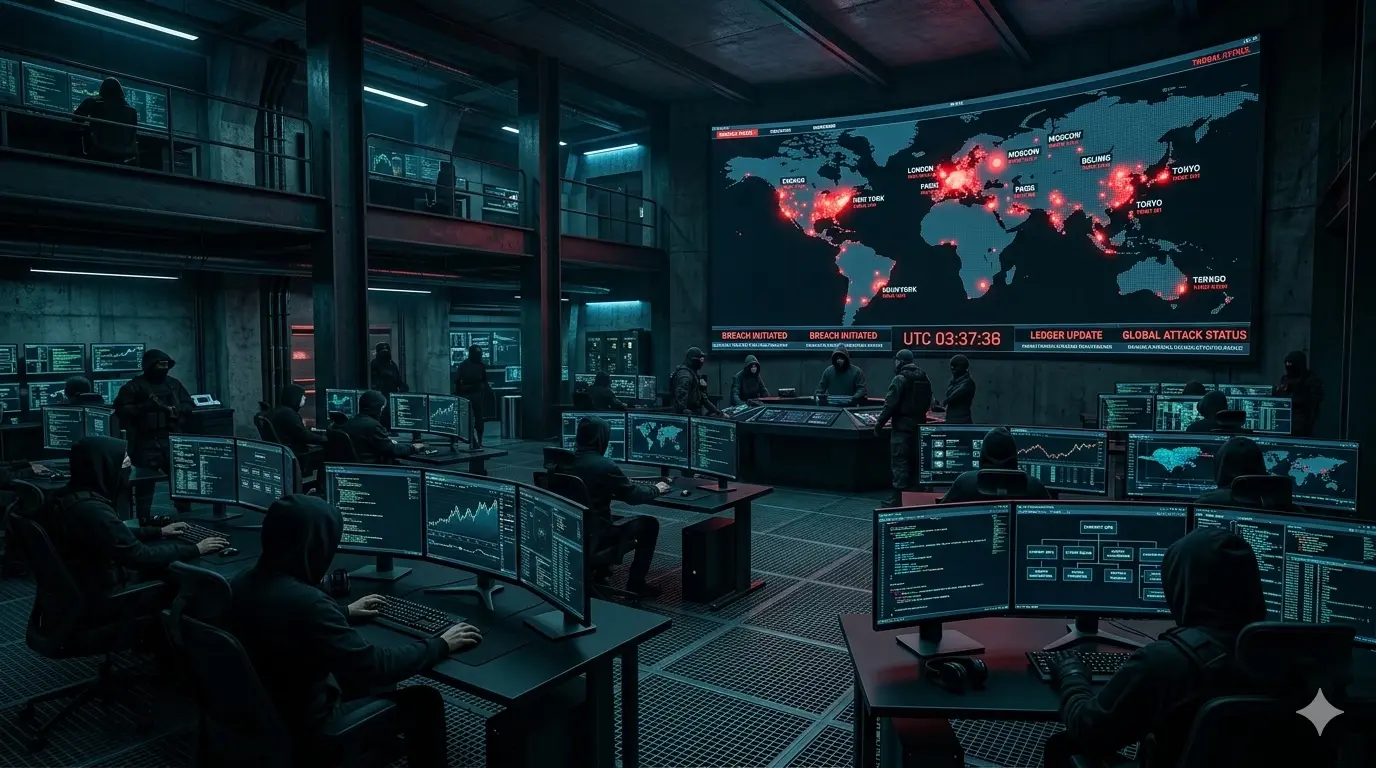
# Inside the Machine: How Ransomware Cartels Became the Most Dangerous Businesses on Earth
The image most people hold in their heads is outdated. The lone hacker. The basement. The energy drinks and stolen Wi-Fi. That world is gone. What replaced it is more dangerous, more sophisticated, and more profitable than anything the cybersecurity world was prepared for.
Today's ransomware operators don't look like criminals. They look like companies.
They have org charts. They have onboarding processes. They have affiliate agreements, revenue splits, and dedicated support channels. Some have HR departments. Some issue internal memos. One group — LockBit — ran a public bug bounty program, offering cash rewards to anyone who found flaws in their own ransomware platform.
Let that sink in.
This is the world of Ransomware-as-a-Service. And if you're not paying attention, it will cost you everything.
---
The Death of the Basement Hacker
Romanticized by Hollywood and misunderstood by boardrooms, the "lone wolf" hacker was always a partial myth. But somewhere between 2016 and 2020, the archetype didn't just evolve — it was systematically replaced.
The shift was economic. Early ransomware operations like CryptoLocker and WannaCry were blunt instruments. Spray attacks. Low ransom demands. Millions of infections for a few hundred dollars each. The model worked until it didn't — law enforcement pressure, better defenses, and diminishing returns forced an evolutionary leap.
The groups that survived got smarter. They got organized.
From Gangs to Syndicates
Modern ransomware cartels — and that word is deliberately chosen — operate with a level of internal structure that mirrors legitimate mid-sized technology companies. Take Conti, the now-defunct Russian-linked group responsible for over $180 million in damages before internal leaks tore them apart in 2022. Those leaks revealed something extraordinary: internal Jabber chat logs showing Conti's organizational hierarchy.
There were team leads. There were developers on salary. There were HR complaints about missed payments. There were managers who conducted performance reviews.
"We are not a gang. We are a business. And like any business, we have standards." — Paraphrased from leaked Conti internal communications, 2022.
This wasn't an anomaly. It was a template.
Groups like BlackCat (ALPHV), LockBit 3.0, and Cl0p all demonstrate varying degrees of this corporate evolution. They maintain customer-facing portals. They publish press releases when they breach major targets. Some maintain dark web "newsrooms" where they announce new victims with the casual confidence of a company announcing a product launch.
The Talent Pipeline
Where do the people come from? Everywhere.
The dark web has functioning job boards. Ransomware cartels post listings for malware developers, penetration testers, negotiators, and cryptocurrency laundering specialists. Salaries are competitive — some developers reportedly earn six figures in cryptocurrency, paid reliably, with bonuses tied to successful deployments.
Recruitment often happens through underground forums like XSS and Exploit. Skill-based auditions are common. One report from cybersecurity firm KELA documented a hiring process involving a technical coding challenge nearly identical to those used by legitimate tech firms.
The talent is real. The motivation is financial. And the organizational infrastructure ensures consistency that no lone wolf could ever match.
---
Ransomware-as-a-Service: The Affiliate Business Model
RaaS didn't invent the franchise model. It stole it.
The concept is almost elegantly simple: a core development team builds the ransomware platform, maintains the infrastructure, handles negotiations, and processes cryptocurrency payments. Then they open the doors to affiliates — external actors who use the platform to conduct attacks in exchange for a percentage of the ransom.
The split varies by cartel. Most operate on a roughly 70/30 or 80/20 model, with the majority going to the affiliate who did the dirty work of infiltrating the target. The cartel takes its cut for providing the weapon, the support structure, and the payment processing.
The Full Stack of Evil
To understand how complete this ecosystem is, walk through what a mid-tier RaaS platform actually provides to its affiliates:
**The Ransomware Builder** — A point-and-click interface to generate customized malware payloads. Affiliates can configure file extension changes, ransom note text, encryption strength, and exclusion lists (to avoid encrypting files that would cause the victim's machine to crash before they can pay). This is drag-and-drop cybercrime.
**The Command and Control Infrastructure** — Bulletproof hosting, often routed through multiple jurisdictions, ensuring the communication channels between the malware and its operators stay live. Affiliates don't build this. It's provided.
**The Victim Portal** — A dark web site where compromised organizations can log in, communicate with their attackers, and negotiate ransom terms. These portals are often professionally designed with live chat support, FAQ sections, and in some cases, a test decryption feature where victims can upload a sample encrypted file to prove the decryption key works.
**The Negotiation Team** — Some cartels handle the ransom negotiation directly. Others provide scripts, guidance, and pricing calculators. Ransom demands are not arbitrary. They are calibrated based on the victim's revenue, cyber insurance policy limits, and the assessed value of the stolen data.
**Cryptocurrency Processing** — Wallets, mixers, and conversion services. The financial backend of a RaaS operation is as sophisticated as some legitimate fintech startups.
The Affiliate Agreement
Yes. There are terms of service.
Cartels publish affiliate agreements on their recruitment portals. These outline what targets are prohibited (hospitals in some cases — though this is often violated), what percentage is owed, and what happens if an affiliate cheats the platform by collecting ransom outside the official channel.
LockBit famously penalized cheating affiliates publicly, posting their names and transaction records to their leak site. Enforcement mechanisms in criminal enterprises. The irony is not lost on anyone.
The RaaS model solved the hardest problem in cybercrime: scaling. Now a moderately skilled attacker anywhere in the world can deploy enterprise-grade ransomware against Fortune 500 companies.
The barrier to entry collapsed. The damage ceiling exploded.
---
The Negotiation Game: Double and Triple Extortion
The first era of ransomware was simple. Encrypt. Demand. Collect. Done.
That model had a fatal flaw: if a victim had working backups, they could restore their systems without paying. By 2019, the cartels noticed their leverage was eroding. So they adapted.
What followed was the systematic weaponization of data itself.
Double Extortion: The Data Hostage
Before deploying encryption, sophisticated ransomware operators now spend weeks — sometimes months — inside a victim's network. They move laterally. They map the environment. They identify the most sensitive data: financial records, personal health information, executive communications, legal documents, source code, customer databases.
Then they steal it. All of it.
When the encryption hits and the victim wakes up to ransom notes on every screen, they also receive a second message: we have your data. Pay or we publish it.
This is double extortion. And it fundamentally changed the calculation for every victim.
Backups don't matter anymore. You can restore from last night's backup and still face the catastrophic public release of your customers' personal data, your trade secrets, your board's private communications. Regulatory exposure alone — GDPR fines, HIPAA penalties, SEC disclosure requirements — can exceed the ransom demand.
The cartels know this. They price accordingly.
Triple Extortion: Turning the Screws
Some groups didn't stop at two leverage points. They added a third.
Triple extortion introduces direct pressure on the victim's stakeholders. The cartel contacts the victim's clients, patients, or partners directly. They email board members. They call executives. They post countdown timers on public dark web sites listing the victim's name and the hours remaining before data drops.
"Your supplier [Company X] has been compromised. Their data, including your contract details, will be published in 47 hours. Encourage them to resolve this matter."
Imagine receiving that email from an anonymous address. Imagine it going to your hospital's patients. Your law firm's clients. Your bank's depositors.
This is calculated psychological warfare. The cartel isn't just pressuring the breach victim — they're mobilizing the victim's entire ecosystem against them.
The Negotiation Theater
Ransom negotiation has become its own dark art. Most large organizations, when hit, engage professional ransomware negotiators — specialized firms that have, in many cases, established working relationships with specific cartel negotiation teams.
The irony is almost unbearable: negotiators who speak regularly to criminal enterprises, developing rapport, understanding acceptable discount ranges, learning which groups accept cryptocurrency alternatives, which ones actually deliver working decryptors.
Cartels maintain their reputations. If LockBit becomes known for taking payment and not providing decryptors, their business model collapses. So most of the established groups honor the transaction. They are, in their perverse way, reliable counterparties.
Discounts happen. Cartel negotiators accept 40–60% reductions in some cases, particularly when victims can demonstrate they lack the ability to pay full price. Some groups offer extended payment plans. One documented case involved a cartel providing technical support to help a victim retrieve their own data more efficiently after paying — because a satisfied customer is less likely to go to law enforcement and more likely to keep quiet.
The entire apparatus is designed around sustainable criminal enterprise.
---
The Geopolitics Behind the Curtain
No analysis of ransomware cartels is complete without naming the elephant in the room: state tolerance.
The majority of the most destructive RaaS groups have operated from Russia, Belarus, and to a lesser extent, Iran and North Korea. The pattern is consistent and documented by agencies including the FBI, CISA, and the UK's NCSC.
These groups are not state-sponsored in the direct sense — meaning governments aren't writing the malware or directing targets. But they operate in an environment of deliberate non-enforcement. As long as attacks target Western organizations, as long as certain rules are followed (don't touch domestic targets, don't hit critical infrastructure that would invite kinetic response), the cartels are left alone.
Some groups have rules hardcoded into their malware: if the system language is set to Russian or certain CIS countries, the malware terminates without executing. This is not a technical quirk. It is a policy.
The ransomware cartel ecosystem is, in effect, an outsourced economic weapon. Plausible deniability wrapped in cryptocurrency and delivered via affiliate network.
This geopolitical shelter is why traditional law enforcement pressure has limited effect. Takedowns happen — Hive, REvil, parts of LockBit's infrastructure — but the groups reconstitute. Members scatter to new brands. The code gets reused. The affiliates find new platforms.
---
What This Means for Every Organization Right Now
The threat intelligence picture is not improving. RaaS platforms are becoming more accessible, not less. Artificial intelligence is beginning to appear in attack tooling — helping groups craft more convincing phishing lures, identify vulnerabilities faster, and automate the early stages of network reconnaissance.
The cartels are investing in R&D. They're improving. The question is whether defenders are improving faster.
A few non-negotiable truths for any security leader:
**Backups are necessary but no longer sufficient.** Offline, immutable backups remain critical, but they don't address data exfiltration. Your incident response plan must include a data exposure scenario.
**Detection speed is everything.** The average dwell time — the period between initial intrusion and ransomware deployment — has been decreasing, but attackers still typically spend days to weeks inside networks before detonating. Behavioral detection, not just signature-based tools, is required to catch them.
**Your supply chain is their entry point.** Third-party vendors, SaaS tools, and remote access solutions are now primary attack vectors. Your security perimeter extends to every organization you trust with access.
**Negotiation is a last resort, not a strategy.** Organizations that pay ransoms fund the next attack. More critically, payment does not guarantee data deletion. Multiple victims have paid and still seen their data published.
**Cyber insurance is not a safety net.** Policies are hardening. Exclusions are expanding. Underwriters have started requiring specific security controls as policy conditions. Insurance may cover part of a loss. It will not cover the reputational damage or the regulatory exposure.
---
The Uncomfortable Conclusion
Ransomware cartels are not a law enforcement problem with a technology component. They are a geopolitical problem with a law enforcement component and a catastrophic technology expression.
They will not be solved by better antivirus software. They will not be deterred by strongly worded indictments that can never be enforced across jurisdictions that don't cooperate. They will not disappear because a major platform gets seized.
They are adaptive, financially motivated, organizationally sophisticated, and operating in a permissive geopolitical environment that has no immediate resolution in sight.
The basement hacker is dead. In its place sits a cartel with a help desk, an affiliate program, a negotiation team, and a data leak site waiting to publish your organization's most sensitive documents on a countdown timer.
The only variable you control is how difficult you make yourself to compromise.
Make it very, very difficult.
---
*This article reflects threat intelligence analysis based on publicly documented incidents, leaked cartel communications, and reporting from cybersecurity firms including Mandiant, CrowdStrike, Recorded Future, and KELA. No operational details that could assist malicious actors have been included.*