The Trojan Horse in Your Living Room
You arrive home after a long day. The smart lock on your front door recognizes your phone and clicks open before you even reach for your keys. Inside, your voice-activated assistant greets you with the weather forecast and turns on the lights. The thermostat has already adjusted to your preferred temperature. Your security camera sends a notification to your phone confirming you are home. Your refrigerator is tracking your grocery inventory. The baby monitor upstairs streams a live feed to your smartphone. Your television remembers exactly where you paused last night's show.
This is the promise of the Internet of Things. Convenience. Automation. The future living in your home right now.
But there is another reality lurking beneath this glossy veneer of technological progress. Every single one of these devices is a potential entry point. A vulnerability. A backdoor into your most private spaces that you willingly installed and plugged into your home network.
The modern obsession with connectivity has transformed our living spaces into something unprecedented in human history. We have voluntarily constructed surveillance networks inside our own homes. We have placed microphones in our bedrooms. We have aimed cameras at our children. We have connected our door locks to the internet. And we have done all of this while trusting that the manufacturers of these devices, companies we have never heard of producing hardware in factories we will never see, have our security and privacy as their top priority.
They do not.
The uncomfortable truth is that the smart home revolution was built on a foundation of negligence. Manufacturers raced to market with internet-connected versions of everyday objects, prioritizing features and price points over fundamental security architecture. They embedded cheap microprocessors running outdated software into thermostats and light bulbs and coffee makers. They configured these devices with laughably weak default passwords. They failed to implement automatic security updates. They left debugging ports open. They transmitted data without encryption.
And then they sold millions of these devices to consumers who had no idea they were installing always-on network nodes that would never receive a single security patch for their entire operational lifetime.
The result is a global infrastructure of compromised devices. A vast, interconnected web of vulnerable endpoints spanning every continent. Billions of smart televisions and voice assistants and door cameras and garage door openers and smart speakers and fitness trackers and connected thermostats, all running insecure firmware, all waiting to be discovered.
And there is a search engine specifically designed to find them.
Meet Shodan: The Search Engine for Hackers
When most people think of search engines, they think of Google. Type in a query, get back a list of websites. Simple. Familiar. Safe.
Shodan is not that kind of search engine.
While Google crawls the visible web indexing HTML pages and blog posts and news articles, Shodan crawls something far more interesting and far more dangerous. Shodan indexes the internet itself. The routers. The servers. The network infrastructure. The industrial control systems. The security cameras. The printers. The smart refrigerators. Every single device connected to the internet that responds when Shodan knocks on its digital door.
Created in 2009 by computer scientist John Matherly, Shodan operates by continuously scanning the entire IPv4 address space, sending requests to every possible IP address and recording what responds. When a device answers, Shodan catalogs its banner information. The type of device. The software version. The open ports. The services running. The geographic location. Everything the device volunteers about itself.
The result is a searchable database of the internet's infrastructure. A map of every internet-connected device on the planet that can be found and fingerprinted.
For security researchers and network administrators, Shodan is an invaluable tool for discovering vulnerable systems and assessing exposure. For penetration testers, it provides reconnaissance capabilities that would have seemed like science fiction two decades ago.
But Shodan does not distinguish between legitimate security researchers and malicious actors. The search engine is available to anyone with an internet connection. The basic service is free. An upgraded account costs less than a streaming service subscription.
This accessibility is what makes Shodan so terrifying.
Anyone, anywhere, can type simple search queries and discover unsecured systems across the globe. A high school student in their bedroom. A cybercriminal in an internet cafe. A state-sponsored hacking group in a fortified compound. They all have access to the same tool, the same data, the same ability to locate vulnerable targets.
The queries are disturbingly simple. Type "default password" and find thousands of devices still using factory credentials. Search for "Server: SQ-WEBCAM" and discover internet-facing security cameras. Look for "port:23" and locate devices with Telnet access enabled, a protocol so insecure it transmits passwords in plain text. Query "has_screenshot:true" and view actual screenshots captured from unsecured systems.
The experience of using Shodan for the first time is deeply unsettling. You type a basic query expecting abstract results, network specifications, technical readouts. Instead, you get human spaces. Live camera feeds showing office corridors. Manufacturing plant control panels displaying real-time production metrics. Traffic light control systems for major intersections. Home routers with their administration panels exposed. Baby monitors streaming nurseries.
The psychological impact of watching this unfold is profound. You begin to understand that privacy is not a setting or a policy or a right. It is an illusion we maintain by assuming the systems around us are secure. That assumption is catastrophically wrong.
Shodan reveals the truth. Your home network, your workplace, the traffic lights you drove through this morning, the hospital where you were born, the power grid supplying electricity to your neighborhood – all of it potentially accessible to anyone who knows where to look.
The search engine has indexed everything from nuclear power plants to industrial waste management systems to maritime vessel tracking systems to casino surveillance networks to prison security systems. It has found parking garage payment kiosas, crematorium control systems, particle accelerators, and wind farm management interfaces. All connected to the internet. Many without authentication. Some actively inviting connection.
Security researchers have used Shodan to discover catastrophic vulnerabilities that manufacturers refused to acknowledge. They have found internet-connected gas station pump controllers. Tesla charging stations with remote control capabilities. Smart city lighting systems controllable by anyone. Water treatment facility SCADA systems with default credentials.
Every device Shodan finds is a device someone assumed was secure. A piece of infrastructure some engineer connected to the network thinking it would be fine. A smart home gadget some consumer installed believing the manufacturer had implemented basic security measures.
They were wrong. And Shodan proves it with clinical precision, updating its database constantly, finding new vulnerable systems every minute of every day.
The Living Room Panopticon: Hijacked Webcams and Baby Monitors
There is a particular category of Shodan results that crosses the line from abstract technical vulnerability into visceral psychological horror. The unsecured cameras streaming live video feeds from inside people's homes.
These are not hypothetical exploits discussed in academic papers. These are real cameras, installed by real people in their living rooms and nurseries and bedrooms, streaming real-time footage to the public internet without authentication. Anyone can watch. No special tools required beyond knowing where to look.
The psychology of this violation operates on multiple levels. First, there is the immediate privacy breach. The knowledge that strangers have been watching your family. Observing your routines. Noting when you leave for work and when you return. Watching your children play. Seeing into spaces you believed were protected by the walls of your home.
But the deeper horror comes from understanding how easily this happens. These cameras were not hacked in the Hollywood sense of sophisticated code-breaking and firewall penetration. They were simply found. They were discovered by search engines because they were configured to be discoverable. The manufacturers shipped them with weak default credentials. Username: admin. Password: admin. Or password: 12345. Or no password at all.
The owners of these cameras installed them, followed the quick start guide, saw the video feed appear on their smartphones, and assumed everything was working correctly. They never changed the default password because the setup wizard never forced them to. They never enabled encryption because they did not know it was an option. They never updated the firmware because they did not know firmware existed.
And so their cameras became public broadcasts. Streams anyone could access by typing an IP address into a browser.
The scale of this exposure is staggering. Security researchers have documented hundreds of thousands of unsecured cameras visible through services like Shodan and specialized directories that aggregate these feeds. Living rooms in Tokyo. Nurseries in London. Office spaces in New York. Retail stores in Mumbai. All streaming continuously. All accessible without authentication.
The psychological impact on victims who discover they have been broadcasting their private lives is devastating. Parents learn that strangers have been watching their children sleep. Families realize that their daily routines have been observable to the internet for months or years. The sanctity of the home, that fundamental sense of safety within your own walls, is shattered by the knowledge that those walls have been transparent.
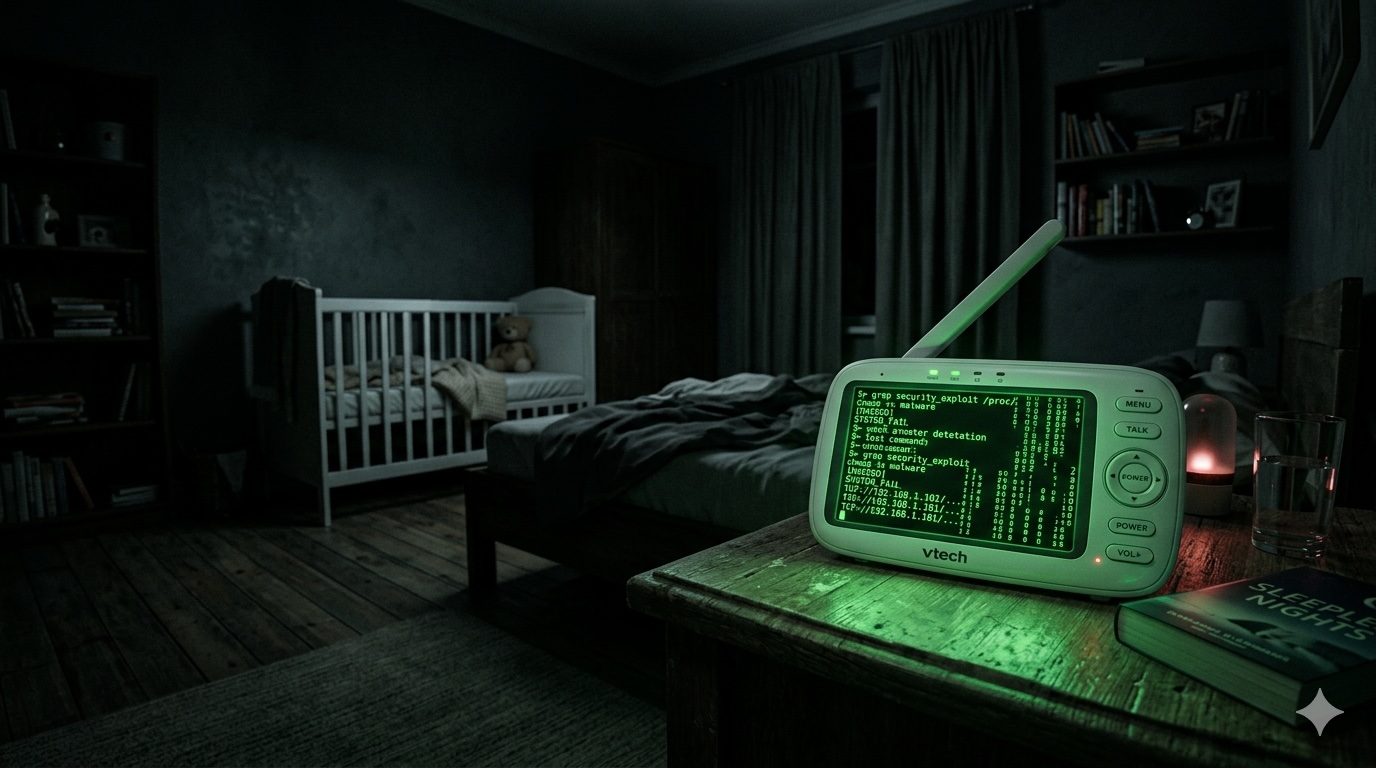
But the violation extends beyond passive observation. Hijacked cameras can be controlled. Attackers can pan and tilt and zoom. They can activate two-way audio, speaking through the camera's speaker into your home. There are documented cases of hackers using compromised baby monitors to shout at children, to harass parents, to demonstrate their control over the device.
The monetization of this access has created a disturbing underground economy. Forums exist where access to residential camera feeds is traded and sold. Collections of credentials for specific camera models circulate on dark web marketplaces. Video clips recorded from compromised cameras are compiled and distributed. The invasion of privacy becomes a commodity.
The manufacturers bear enormous responsibility for this crisis. They produced devices designed to operate in intimate spaces and connected them to the internet with minimal security considerations. They failed to require password changes during setup. They hardcoded credentials into firmware. They transmitted video streams without encryption. They released products knowing they would never provide security updates.
The firmware running on millions of these cameras contains known vulnerabilities that will never be patched. The devices will continue operating with those vulnerabilities for years, broadcasting from homes and offices until they physically fail. The manufacturers have moved on to newer models, abandoning support for products still in active use.
This is the reality of the connected camera industry. Cheap hardware running insecure software deployed in the most private spaces of human life. Devices that transform your nursery into a public viewing room. Equipment that converts your sense of home security into a false comfort while broadcasting your vulnerabilities to anyone interested enough to look.
The smart baby monitor on your nightstand, the one streaming peaceful footage of your sleeping infant to your phone, might also be streaming that same footage to dozens of strangers. The security camera you installed to protect your home might be the very mechanism through which your home is being surveilled. The convenience you purchased came with a cost you never agreed to pay: the exposure of your private life to the public internet.
The Zombie Army: Botnets and the Mirai Precedent
The threat posed by insecure IoT devices extends far beyond privacy invasion. These devices, compromised en masse, become weapons. Infrastructure for launching attacks that can destabilize critical internet services and target organizations anywhere in the world.
This is the botnet threat. Networks of infected devices controlled remotely by attackers and coordinated to act in concert. Your smart camera, your DVR, your home router, conscripted into a digital army without your knowledge or consent, participating in cyberattacks while sitting innocuously on your living room shelf.
The watershed moment that forced global attention to this threat was the Mirai botnet in 2016. Mirai was elegant in its simplicity and devastating in its impact. The malware scanned the internet for IoT devices running on specific default credentials. When it found a vulnerable device, it infected it, turning it into a bot under the attacker's control. Then it used that newly infected device to scan for more victims, spreading exponentially across the internet.
The infection vector was absurdly simple. Mirai tried a list of sixty-two common default username and password combinations. Admin/admin. Root/root. Default/default. If any worked, the device was compromised. No sophisticated exploit. No zero-day vulnerability. Just manufacturers shipping products with unchangeable or unchanged default credentials.
At its peak, Mirai infected over six hundred thousand devices. Security cameras. Digital video recorders. Home routers. Internet-connected appliances. All running Linux-based firmware. All accessible via Telnet or SSH. All using predictable credentials. The botnet turned this massive fleet of consumer devices into distributed denial-of-service attack infrastructure.
The attacks launched by Mirai were unprecedented in scale. In September 2016, the botnet targeted cybersecurity journalist Brian Krebs's website with a DDoS attack exceeding 620 gigabits per second. The assault was so massive it forced Akamai, one of the world's largest content delivery networks, to stop providing free protection to Krebs. The attack came from hundreds of thousands of individual devices, each contributing a small stream of traffic that aggregated into an overwhelming flood.
The following month, Mirai targeted Dyn, a major DNS provider. The attack disrupted access to Twitter, Netflix, Reddit, GitHub, Spotify, and dozens of other major websites across the United States and Europe. Millions of users found themselves unable to access essential internet services because someone had weaponized an army of compromised security cameras and DVRs.
The psychological shift this represented was profound. IoT devices were no longer just privacy risks to their owners. They were threats to internet infrastructure itself. Your insecure webcam was not just broadcasting your living room. It was potentially participating in attacks against hospitals, financial institutions, and critical infrastructure.
The Mirai source code was released publicly in October 2016, spawning countless variants and successor botnets. Hajime, which infected hundreds of thousands of devices. Reaper, which targeted known vulnerabilities in specific IoT device models. Hide and Seek, which persisted across reboots. Each generation became more sophisticated, but the fundamental vulnerability remained: manufacturers continuing to ship devices with inadequate security.
The botnet threat is permanent and growing. Every insecure device added to the internet is a potential bot. Every DVR with a default password. Every router with an unpatched vulnerability. Every smart camera running outdated firmware. The aggregate computing power and bandwidth of millions of compromised devices creates attack infrastructure more powerful than anything previous generations of cybercriminals could access.
The attacks enabled by these botnets target critical infrastructure. Financial institutions. Healthcare systems. Government networks. The devices in your home, infected and controlled remotely, might be used to attack the hospital where you receive treatment or the bank where you store your savings. The convenience device you installed has been repurposed as an attack vector.
What makes this threat particularly insidious is the invisibility of the compromise. Your infected camera still streams video to your phone. Your compromised router still provides internet access. The device functions normally from your perspective while simultaneously participating in criminal activity. You have no indication that anything is wrong until perhaps you notice your internet connection slowing during peak bot activity, and even then, you likely attribute it to network congestion.
The manufacturers who produced these vulnerable devices face no meaningful consequences. There is no regulatory framework holding them accountable for shipping insecure products. No liability when their cameras are recruited into botnets. No requirement to provide security updates or even to disclose known vulnerabilities. They sold the devices, collected the revenue, and moved on.
Meanwhile, those devices continue operating. Still vulnerable. Still accessible. Still scanning for instructions from command and control servers. Zombie soldiers in an ongoing war most device owners do not know they are part of.
Securing the Digital Castle: Your IoT Survival Guide
The threat landscape is bleak. The vulnerabilities are structural. The manufacturers are negligent. But capitulation is not an option. You can harden your digital perimeter. You can reduce your attack surface. You can implement security measures that dramatically decrease the likelihood of compromise.
This is your survival protocol.
First and most critical: change every default password immediately. The moment you connect a new IoT device to your network, access its administrative interface and change the credentials. Not to a simple password. Not to a variation of the default. To a strong, unique password generated by a password manager. Minimum fifteen characters. Mix of uppercase, lowercase, numbers, and symbols. Store it securely. Never reuse it across devices.
This single action eliminates the attack vector that enables most IoT compromises. Botnets like Mirai cannot infect devices with changed credentials. Opportunistic attackers using Shodan cannot gain access with default passwords. This is not theoretical hardening. This is practical elimination of the most common entry point.
Second: update firmware obsessively. Check for updates monthly. Enable automatic updates if the device supports them. Manufacturers rarely push updates, but when they do, those updates often patch critical vulnerabilities. An unpatched device is a device running exploitable code. Every day you delay an update is another day your device is vulnerable to known attacks.
Understand that many devices will never receive updates. The manufacturer has abandoned them. In those cases, you face a choice: accept the permanent vulnerability or remove the device from your network. There is no middle ground. An abandoned IoT device is a permanent security liability.
Third: implement network segmentation. Do not allow IoT devices on the same network as your computers and phones. Create a separate network for smart home devices. Most modern routers support guest networks or VLANs. Configure a dedicated IoT network with no access to your primary network. If a device is compromised, the attacker gains access only to other IoT devices, not to your personal computers containing sensitive data.
This requires reconfiguring your network architecture, but the security benefit is substantial. A compromised camera cannot pivot to your laptop. An infected DVR cannot access your phone. The blast radius of any compromise is contained to the IoT segment.
Fourth: disable UPnP on your router. Universal Plug and Play allows devices to automatically configure port forwarding, punching holes through your firewall without your knowledge. This convenience feature is a security catastrophe. It allows devices to make themselves accessible from the internet without administrator approval. Disable it in your router settings. Configure port forwarding manually only for services that absolutely require external access.
Fifth: audit your IoT devices regularly. Maintain an inventory of every connected device on your network. Use network scanning tools to identify what is actually connected. Look for devices you do not recognize. Investigate unexpected traffic patterns. Many compromises go undetected for months because owners are not monitoring their networks. Active vigilance is required.
Sixth: research before purchasing. Not all IoT manufacturers are equally negligent. Some prioritize security. Some provide regular firmware updates. Some require password changes during setup. Before buying a connected device, research the manufacturer's security track record. Read security advisories. Check how long they support products with updates. Avoid brands with documented histories of abandoning devices or shipping products with hardcoded credentials.
Seventh: disable features you do not use. Remote access. Cloud connectivity. Voice control. Every enabled feature is a potential attack vector. If you do not need remote access to your camera when away from home, disable it. If you do not use the cloud storage feature, turn it off. Minimize your exposure by minimizing enabled functionality.
Eighth: use a firewall that provides visibility and control. Consumer routers have improved, but many still provide minimal traffic inspection. Consider upgrading to a router or firewall appliance that logs traffic, blocks known malicious IPs, and provides alerts for suspicious activity. Security is not a one-time configuration. It requires ongoing monitoring.
Ninth: accept that convenience and security are often at odds. The most secure IoT device is the one you do not connect to your network. Every connected device increases your attack surface. Evaluate whether the convenience genuinely improves your life enough to justify the risk. A smart light bulb controlled by your phone is convenient. A light switch controlled by your hand is more secure. Choose deliberately.
Tenth: stay informed. The threat landscape evolves constantly. New vulnerabilities are disclosed daily. New botnets emerge regularly. Subscribe to security newsletters. Follow researchers who specialize in IoT security. Understand the threats that apply to your specific devices. Security is not achieved through a one-time checklist. It requires ongoing education and adaptation.
The reality is that perfect security is impossible. Manufacturers will continue shipping vulnerable devices. New zero-day exploits will be discovered. State-sponsored actors will develop sophisticated attacks. But you can make yourself a harder target. You can implement defenses that deflect opportunistic attacks. You can reduce your risk profile from catastrophic to manageable.
The smart home revolution happened without adequate security architecture. We are living with the consequences. Billions of vulnerable devices. Global botnet infrastructure. Pervasive surveillance capabilities. The threat is real and permanent.
But you are not powerless. You can secure your digital perimeter. You can protect your private spaces. You can prevent your devices from being weaponized. The tools and knowledge exist. The question is whether you will use them.
Your home is not a castle if the drawbridge is permanently down and the gates are wide open. Every IoT device with a default password is an open gate. Every unpatched camera is an unwatched entrance. Every device on your primary network is a foothold for lateral movement.
Secure your devices. Segment your network. Monitor your traffic. Update relentlessly. Question every connection. Accept that convenience comes with cost.
The internet of things is not going away. The only question is whether you will be a victim of its vulnerabilities or a practitioner of defensive security. The choice, and the responsibility, are yours.